
China Best Wooden Garage Doors for Global Buyers
China Best Wooden Garage Doors for Global Buyers
Wooden garage doors are gaining attention among buyers seeking warmth, craftsmanship, and architectural character. They can transform a plain façade into a more welcoming entrance. However, beauty alone is not enough. Buyers must examine timber species, moisture control, hardware quality, insulation, and export packaging.
Fortune Business Insights estimates that the global garage door market reached approximately USD 3.43 billion in 2023. Its research also forecasts continued growth through 2032, supported by residential construction and replacement demand. Grand View Research identifies customization, energy performance, and improved materials as important market trends. These findings support China’s position as a competitive sourcing base, especially for made-to-order wooden garage doors.
Still, the data has limits. Most reports group wood with broader garage door categories. Direct figures for wooden garage doors remain difficult to separate. That uncertainty deserves attention.
Tom Wadsworth, a recognized garage door training specialist, states, “A garage door is a system, not just a panel.” This principle matters when evaluating Chinese suppliers. A well-made door includes balanced springs, suitable tracks, reliable seals, and tested operating mechanisms. The timber should arrive dry, stable, and properly finished. Small cracks around joints may become serious after repeated humidity changes.
Experienced buyers should request coating specifications, wood moisture readings, installation drawings, warranty terms, and packaging photographs. Ask how the manufacturer protects edges during ocean transport. Ask again about replacement parts.
China offers strong manufacturing capacity and design flexibility. Yet not every factory delivers the same consistency. A beautiful sample proves little. Factory audits, third-party inspections, and clear technical contracts create greater confidence for global buyers.
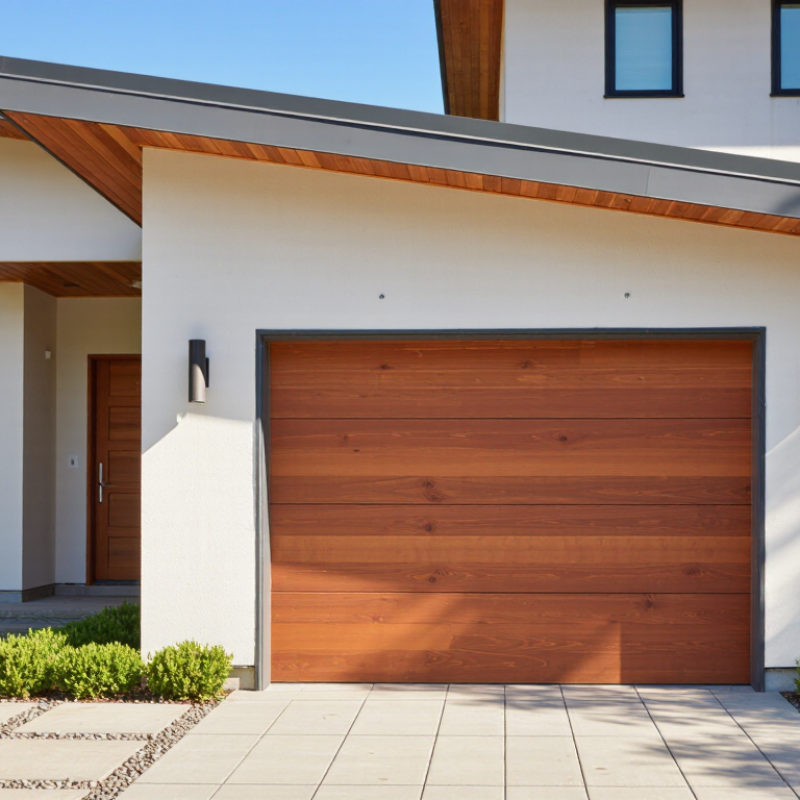
Chinese Wooden Garage Doors: Species, Construction, Standards, and Sourcing
China Best Wooden Garage Doors for Global Buyers
Chinese Wooden Garage Doors: Species, Construction, Standards, and Sourcing
For global buyers, wood selection should follow climate, not appearance. Cedar suits damp regions because it resists moisture naturally. Larch and oak provide strength, but they require careful sealing. Pine costs less and accepts paint well. In practical inspections, kiln-dried timber should show stable moisture readings, often around 8–14 percent. That range still needs adjustment for the destination climate.
Construction quality appears at the joints. Look for laminated rails, reinforced stiles, corrosion-resistant fasteners, and accurate panel alignment. Solid wood can look impressive, yet it may move more than engineered timber. A layered core can reduce warping. Small gaps matter. Standards are not interchangeable. Ask for documented testing against the destination market’s requirements for wind pressure, operation safety, thermal performance, and fire behavior. Reports should identify the tested product, laboratory, date, and production details. A certificate without traceable evidence is weak.
Sourcing requires technical documents before price negotiations. Request drawings, timber species, moisture records, coating specifications, hardware lists, packing details, and installation instructions. Inspect a production sample under sunlight and simulated rain. Check whether the finish reaches end grain and panel edges. A perfect sample can mislead. Factory audits should review batch labels, calibration records, and repair procedures. I would also confirm spare hardware availability and written warranty limits. This step is often overlooked. It can become expensive later.
China Best Wooden Garage Doors for Global Buyers - Chinese Wooden Garage Doors: Species, Construction, Standards, and Sourcing
| Category | Wood Species or Specification | Typical Technical Data | Advantages for Garage Doors | Limitations and Maintenance | Recommended Use |
|---|---|---|---|---|---|
| Wood Species | Western Red Cedar |
Density: approximately 320–380 kg/m³ at 12% moisture content. Janka hardness: approximately 350 lbf (1,560 N). |
Lightweight, dimensionally stable, naturally resistant to decay, and easy to machine. Its natural oils support outdoor use when properly finished. | Softer than many hardwoods and more vulnerable to dents and surface wear. Requires regular sealing or staining, especially on exposed faces. | Premium exterior doors in damp or coastal climates when a low-weight construction is preferred. |
| Wood Species | Douglas Fir |
Density: approximately 480–530 kg/m³ at 12% moisture content. Janka hardness: approximately 660 lbf (2,930 N). |
Good strength-to-weight ratio, straight grain, reliable availability, and suitable screw-holding performance. | Not naturally decay-proof. All exposed surfaces, end grain, joints, and bottom edges need a suitable exterior coating and periodic inspection. | Painted or stained sectional, carriage-house, and side-hinged garage doors. |
| Wood Species | European Oak |
Density: approximately 650–750 kg/m³ at 12% moisture content. Janka hardness: approximately 1,360 lbf (6,050 N). |
Hard, durable, attractive grain, and strong resistance to everyday impact when correctly engineered and finished. | Heavy and relatively costly. Natural movement can cause splitting or joint stress if moisture content and panel construction are not controlled. | High-end doors requiring a substantial appearance and strong surface durability. |
| Wood Species | Accoya-Style Modified Softwood | Wood is commonly modified through acetylation to reduce moisture-related movement. Performance depends on the certified treatment system and substrate. | Improved dimensional stability and biological durability compared with untreated softwood. Suitable for demanding exterior applications. | Higher material cost. The supplier must provide treatment documentation, coating compatibility data, and warranty conditions. | Exterior doors exposed to frequent rain, high humidity, or large seasonal temperature changes. |
| Wood Species | Finger-Jointed or Laminated Pine |
Typical density: approximately 400–550 kg/m³, depending on species and moisture content. Structural performance depends on adhesive quality and joint design. |
Cost-effective, widely available, easy to paint, and suitable for engineered stiles, rails, and decorative face components. | Exposed finger joints require reliable sealing. Untreated or poorly bonded components may absorb moisture and show joint movement. | Paint-grade doors where controlled cost and consistent component dimensions are important. |
| Door Construction | Solid Timber Stile-and-Rail | Uses vertical stiles, horizontal rails, and floating or fixed panels. Typical door thickness: approximately 40–60 mm, subject to design and hardware. | Traditional appearance, repairable components, and strong visual character. Floating panels can accommodate limited seasonal wood movement. | Heavier than engineered panels. Wide solid panels can warp, split, or shrink if moisture content is not controlled. | Traditional carriage-house or side-hinged designs with architectural detailing. |
| Door Construction | Engineered Wood Sandwich Panel | Typical build-up: exterior wood skin, moisture-resistant core, internal reinforcement, and interior face. Common overall thickness: approximately 40–50 mm. | Better dimensional stability than wide solid boards, lower risk of warping, and easier integration with insulation and sectional-door hardware. | Edge sealing and drainage are critical. Damaged skins or unsealed cut-outs can allow water to reach the core. | Sectional overhead doors requiring improved thermal and dimensional performance. |
| Door Construction | Insulated Sectional Door | Common core materials include polyurethane or polystyrene. Thermal performance is normally reported as U-value or R-value and must be verified for the complete door assembly. | Reduces heat transfer and noise compared with a single-layer door. Can combine a wood exterior appearance with a reinforced insulated structure. | A higher insulation claim does not guarantee whole-door performance. Seals, glazing, joints, and installation quality also affect results. | Attached garages, cold climates, heated workshops, and energy-conscious residential projects. |
| Moisture Control | Exterior Coating System | All faces, edges, end grain, joints, and hardware penetrations should be sealed. Moisture content is commonly targeted near 8–12% before interior assembly, subject to local climate and specification. | Reduces uneven moisture absorption, coating failure, swelling, and dimensional movement. | Coatings do not eliminate maintenance. Bottom edges, weather-exposed joints, and areas around windows require frequent inspection. | Essential for all exterior wooden garage doors shipped to regions with changing humidity or rainfall. |
| Hardware | Counterbalance and Operating Hardware | Springs, cables, rollers, tracks, hinges, and lifting mechanisms must be selected for the finished door weight and cycle rating. | Correctly matched hardware improves safe operation, service life, and balance across the full opening. | Hardware sizing cannot be based on door dimensions alone. Wood moisture gain may increase weight after installation. | All overhead doors, particularly heavy solid-wood or glazed constructions. |
| Safety Standard | EN 13241 | European product standard for industrial, commercial, and garage doors and gates. It addresses performance characteristics such as wind load, water tightness, and thermal properties where applicable. | Provides a recognized framework for product performance documentation in European markets. | Compliance depends on the complete door system, intended use, declared characteristics, and applicable national requirements. | Projects supplied to the European Economic Area, subject to the buyer’s regulatory review. |
| Safety Standard | EN 12453 | European safety requirements and test methods for power-operated doors and gates, including protection against crushing, impact, and other operating hazards. | Helps define safety functions for motorized garage-door systems. | A manual door and a powered door may have different obligations. Motor, controls, sensors, and door hardware must be assessed together. | Motorized overhead or side-sliding garage doors supplied for European applications. |
| Safety Standard | ASTM F2200 | U.S. standard covering the construction and performance of motorized residential garage doors. | Useful for checking entrapment protection, mechanical design, and requirements relevant to automatic residential doors. | It should be reviewed together with applicable U.S. building codes, operator requirements, and installation instructions. | Motorized residential garage doors intended for the United States market. |
| Safety Standard | UL 325 | U.S. safety standard for door, gate, drapery, louver, and window operators and systems, including protection against entrapment hazards. | Provides a recognized basis for evaluating automatic operator safety and monitored protective devices. | Certification and listing requirements may apply to the operator and complete installation, not merely to the wooden door leaf. | Automatic garage-door operators and complete powered door systems for North American projects. |
| Performance Testing | Wind Load and Structural Resistance | Design values depend on opening size, building location, wind exposure, building height, and local code. A generic wind rating should not be assumed. | Proper engineering helps prevent panel deformation, track failure, and loss of door integrity during severe weather. | The buyer should request project-specific calculations or test evidence rather than relying only on a material description. | Coastal, hurricane-prone, typhoon-prone, or high-wind regions. |
| Packaging and Logistics | Export Packaging | Use moisture-resistant wrapping, corner protection, rigid crates or reinforced cartons, desiccant where appropriate, and shock or tilt indicators for sensitive shipments. | Reduces damage from impact, vibration, humidity, and stacking during international transportation. | Packaging must allow ventilation where needed and should not trap condensation against unfinished wood surfaces. | Sea freight, long-distance container transport, and deliveries through humid or variable climates. |
| Wood Packaging Compliance | ISPM 15 | International standard for phytosanitary measures covering solid wood packaging material such as pallets, crates, and dunnage. Heat treatment or another approved treatment and marking may be required. | Supports smoother customs clearance and reduces the risk of introducing timber pests through export packaging. | ISPM 15 applies to solid wood packaging material, not automatically to the wooden garage door itself. Import-country rules still need confirmation. | International shipments using solid wood pallets, crates, or blocking materials. |
| Sourcing Documentation | Technical Submittal Package | Recommended documents include species declaration, moisture-content records, coating specification, drawings, dimensions, hardware schedule, installation instructions, test reports, and maintenance guidance. | Improves comparison between suppliers and reduces uncertainty about performance, installation, and after-sales service. | Documents should match the actual production model, configuration, glazing, hardware, and destination-market requirements. | Commercial procurement, project tenders, custom sizes, and repeat orders. |
| Quality Inspection | Pre-Shipment Inspection Points | Check dimensions, squareness, surface defects, moisture content, coating coverage, panel movement, hardware operation, glazing, labels, packaging, and supplied accessories. | Identifies manufacturing or packing problems before the goods leave the exporting country. | Inspection criteria should be agreed in writing before production, including acceptable tolerances and photographic records. | Every custom or repeat international order, especially when site replacement is expensive. |
Related Posts
-
What are the Benefits of Choosing Wood Look Garage Doors for Your Home
-

Best Wood Look Garage Doors for Your Home Transformation?
-
5 Best Garage Door Options for Boosting Your Home's Curb Appeal
-

Are Wood Look Garage Doors Worth the Investment?
-
What Are Glass Garage Doors and Are They Worth It?
-
7 Best Features of Double Garage Doors You Didn't Know About!